Alhambra or Generalife First? The Architectural Logic
Alhambra and Generalife sit on different hills with different functions. Visit the Nasrid Palaces first, gardens second — here is why.
You see them on the map sitting side by side and assume they are the same place. They are not. The Alhambra and the Generalife are on two different hills, served two completely different functions for the Nasrid sultans, and were physically separated by a small valley that visitors still cross today. Which one you see first matters less than understanding why both were built — but the order does affect the day. The 3-hour Alhambra and Generalife guided tour covers both, and a good guide explains the architectural argument that links them.
The 90-Second Geography
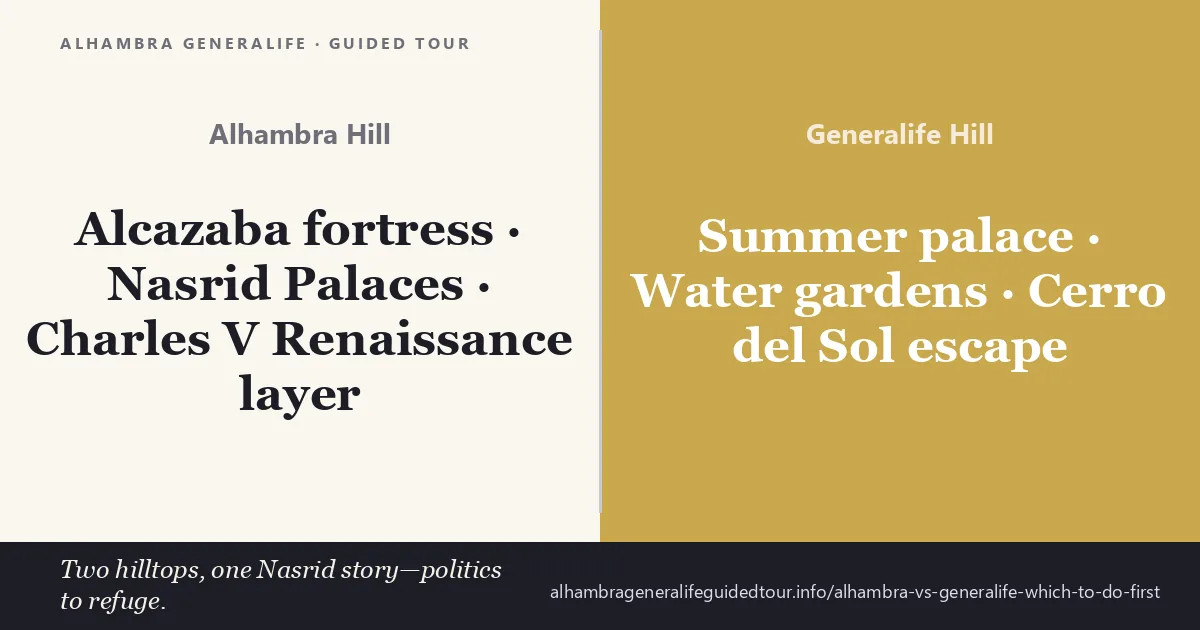
The Alhambra hill (in Arabic, al-Qalʿa al-Ḥamrāʾ, “the Red Fortress” — referring to the original Alcazaba citadel walls visible across Granada at sunset) is the larger of the two, holding the Alcazaba military fortress, the Nasrid royal palaces, and the medieval Medina where the court craftsmen and servants lived. The Generalife (in Arabic, Jannat al-ʿArīf, “the Architect’s Garden” or “the Garden of the Skilled One”) sits about 200 m east, on the Cerro del Sol, connected to the Alhambra by a path through the gardens of the Partal. Same family of sultans built both. Different purposes.
| Aspect | Alhambra | Generalife |
|---|---|---|
| Function | Fortified citadel + royal residence | Summer retreat + ornamental gardens |
| Hill | Sabika | Cerro del Sol |
| Components | Alcazaba, Nasrid Palaces, Medina, Charles V Palace | Gardens, palace pavilions, water channels |
| Construction | 9th century (Alcazaba), 13th-14th century (palaces) | 13th-14th century (Nasrid period) |
| Built by | Muhammad I onward (Nasrid dynasty 1232-1492) | Muhammad III, expanded by later sultans |
| Use today | Public monument, timed-entry Nasrid Palaces | Public gardens, lower-pressure ticketing |
The Nasrid dynasty (1232-1492) was the last Muslim dynasty on the Iberian Peninsula. Both sites were built and refined across their 260-year rule by successive sultans rather than in one campaign: Muhammad III established the original Mexuar council chamber around 1303 (later modified by Ismaʿīl I and Muhammad V), Yusuf I built the Comares Palace as the diplomatic heart of the complex during his reign of 1333-1354, and Muhammad V completed the Court of the Lions during his second reign around 1370. The arc ended with the surrender of the Alhambra by Boabdil (Abu Abdullah Muhammad XII) to the Catholic Monarchs on 2 January 1492. The transition closed the period of al-Andalus and reshaped both sites under Castilian then Habsburg rule, most visibly when Charles V commissioned his Renaissance palace inside the Alhambra in 1526 with construction officially beginning in 1527. Together with the Albayzín quarter (added as an extension to the inscription in 1994), the Alhambra and Generalife were placed on the UNESCO World Heritage List in 1984 under criteria (i), (iii) and (iv).
Why Visit the Alhambra First
Three reasons.
Timed slots force the issue. The Nasrid Palaces operate on 30-minute timed-entry windows — your ticket reserves a specific slot, and you cannot enter before it. The Generalife has no such constraint. Building the day around the Nasrid Palaces slot is the only schedule that works; everything else flexes around it.
The argument runs Alhambra → Generalife. The Nasrid Palaces present the political, ceremonial, and religious heart of the dynasty: the Mexuar (judicial), the Comares Palace (diplomatic), the Court of the Lions (private royal). The Generalife is the escape from those rooms — a place where sultans went to think, to walk, to be among water channels and cypress arcades. The story makes more sense in that order. Seeing the gardens first turns them into “nice gardens”; seeing them after the Comares Palace turns them into “where they fled the politics.”
Light is on your side in the morning. The Nasrid Palaces stuccowork is best viewed in soft side-light, which means morning (08:30 first slot, 09:30 second). The Generalife gardens look better in late afternoon as the sun angles low across the rill water channels. The natural flow is morning Alhambra, late-morning to early-afternoon Generalife.
What the Guided Tour Order Actually Is
The featured 3-hour Alhambra and Generalife guided tour follows this sequence:
- Meet at one of the 15 starting points; orientation on Nasrid dynasty history (10 min)
- Alcazaba fortress walk — Torre de la Vela views over Albayzín and Sierra Nevada (30-40 min)
- Nasrid Palaces — Mexuar, Comares, Court of the Lions (60 min, locked to your timed slot)
- Walk to the Generalife — water gardens, pavilions, cypress arcades (45 min)
- Charles V Palace courtyard + Plaza de los Aljibes finish (15 min)
Some guides reverse steps 2 and 3 depending on the timed slot the operator assigned you (if your Nasrid slot is 09:00, you go to Nasrid first; if it’s 11:00, you go to the Alcazaba first to fill the time). The Generalife is always second-half because it has no timed entry and works as a relaxing close to the visit.
“Can I Just Visit the Generalife?”
Yes — there is a Generalife-only ticket that bypasses the Alhambra ticketed zones. Several operators offer Generalife-focused tours (typically 2-2.5 hours, around $50 per person). For a first visit, this is a mistake. You miss the Nasrid Palaces, the architectural climax of the whole site. The gardens are beautiful but they are the postscript, not the headline. Save the Generalife-only ticket for a return visit.
“Can I Just Visit the Alhambra (Without Generalife)?”
You can buy an Alhambra entry ticket without Generalife access, but every guided tour bundles both — and the combined ticket costs the same as the Alhambra-only ticket from the operator’s perspective. There is no money saved by skipping the Generalife. Don’t skip it.
How Long for Each?
| Zone | Realistic time | Maximum if rushed |
|---|---|---|
| Alcazaba | 30-40 minutes | 20 minutes |
| Nasrid Palaces | 60 minutes (timed slot) | 45 minutes |
| Generalife | 45 minutes (guided) or 60-90 minutes (free time) | 30 minutes |
| Charles V Palace | 15 minutes | 5 minutes |
| Combined guided tour | ≈3 hours | — |
| Full self-paced visit | 4-5 hours | — |
If you have one day in Granada and want both sites at their best, the 3-hour guided tour is the right scope. If you have a second morning free, return to the Generalife alone — it absorbs slow, unguided time better than the Alhambra does.
The Cultural Layering Worth Knowing
Charles V’s Renaissance palace was begun inside the Alhambra in 1527 to a design by Pedro Machuca, the Toledo-trained architect who had studied in Italy. Machuca died on 4 June 1550 with the building only partly raised, and the palace then sat structurally unfinished for centuries — open to the sky and used variously as a quarry, a parade ground, and a storehouse — until its concrete roof was finally completed in 1957, the same year the upper floor became home to the Museum of Fine Arts of Granada. The building is sometimes read as a Christian-Catholic imposition on an Islamic complex; the more interesting reading is as a layering — a Renaissance circle-in-square geometry placed in conversation with the Nasrid muqarnas vaulting next door. Modern Spanish heritage scholarship increasingly treats the al-Andalus heritage and the Renaissance overlay as both core Spanish heritage, not as foreign occupation followed by reclamation.
This matters because most visitors arrive expecting “Islamic site” or “Spanish site” and find both, layered. The honest framing is that the Alhambra and Generalife together preserve a 700-year arc that includes Nasrid construction, Castilian transition, Habsburg layering, 19th-century romantic restoration (Washington Irving’s Tales of the Alhambra, first published in May 1832 in London and Philadelphia under the pseudonym Geoffrey Crayon, made the site internationally famous and helped trigger Rafael Contreras’s long restoration campaign from 1847 to 1889), and 20th-century conservation under Leopoldo Torres Balbás, who served as Alhambra director from 1923 to 1936 and pioneered scientific conservation methods before being removed at the start of the Spanish Civil War. All of those layers are visible — your guide will point them out.
The Water That Makes the Generalife Work
One detail most first-time visitors miss: the Generalife gardens are not a natural oasis. They are the visible end of a deliberately engineered hydraulic system. Snowmelt from the Sierra Nevada is captured at Jesús del Valle and routed via the Acequia Real (Royal Canal) — a roughly six-kilometre channel built in the 13th century with a precise gradient of around 2 to 3 per thousand to keep the flow steady. The channel feeds the Patio de la Acequia directly through the central rill that defines the courtyard, with branch acequias de careo in the mountains above used to recharge aquifers through soil filtration. The Court of the Lions fountain — whose 12 verses carved around the basin are an ode by the Nasrid court poet Ibn Zamrak to Sultan Muhammad V — sits at the architectural climax of the same water network, with the lions and basin confirmed (during the 2002-2012 restoration) to have been carved from a single block of Macael marble in the 14th century. Knowing this changes what the rill, the fountains and the cypress arcades feel like on the walk through.
A Practical Closing Tip
If you can, allow 30 minutes of unhurried time at the Court of the Lions after the guide finishes — this is the architectural climax of the whole visit and many groups rush it to keep on schedule. Tell your guide at the start that you’d like a few minutes alone there; most accommodate. Then walk to the Generalife at a slower pace than the guide sets. The site rewards lingering.
Ready to Book?
The featured 3-hour Alhambra and Generalife guided tour covers both sites in the natural order — Alcazaba first, Nasrid Palaces in your timed slot, Generalife as the close — with a Patronato-licensed guide, multilingual headset, and all entrance tickets bundled. From $63 per person, rated 4.7/5 by 21,743 verified guests. Check availability for your dates.
See the Alhambra — Nasrid Palaces, Generalife, Tickets in Hand
A three-hour Alhambra and Generalife guided tour with Patronato-licensed guide, all Nasrid Palaces / Alcazaba / Generalife tickets included, and multilingual headsets — from $63 per person.
Check Availability & Book